Why Does Every Beauty Brand Suddenly Look Like Breakfast?
Baguette ties, lip gloss in martini glasses, Tiffany on toast. A breakdown of gastro-marketing — the sensory strategy quietly hijacking your appetite to sell you beauty.
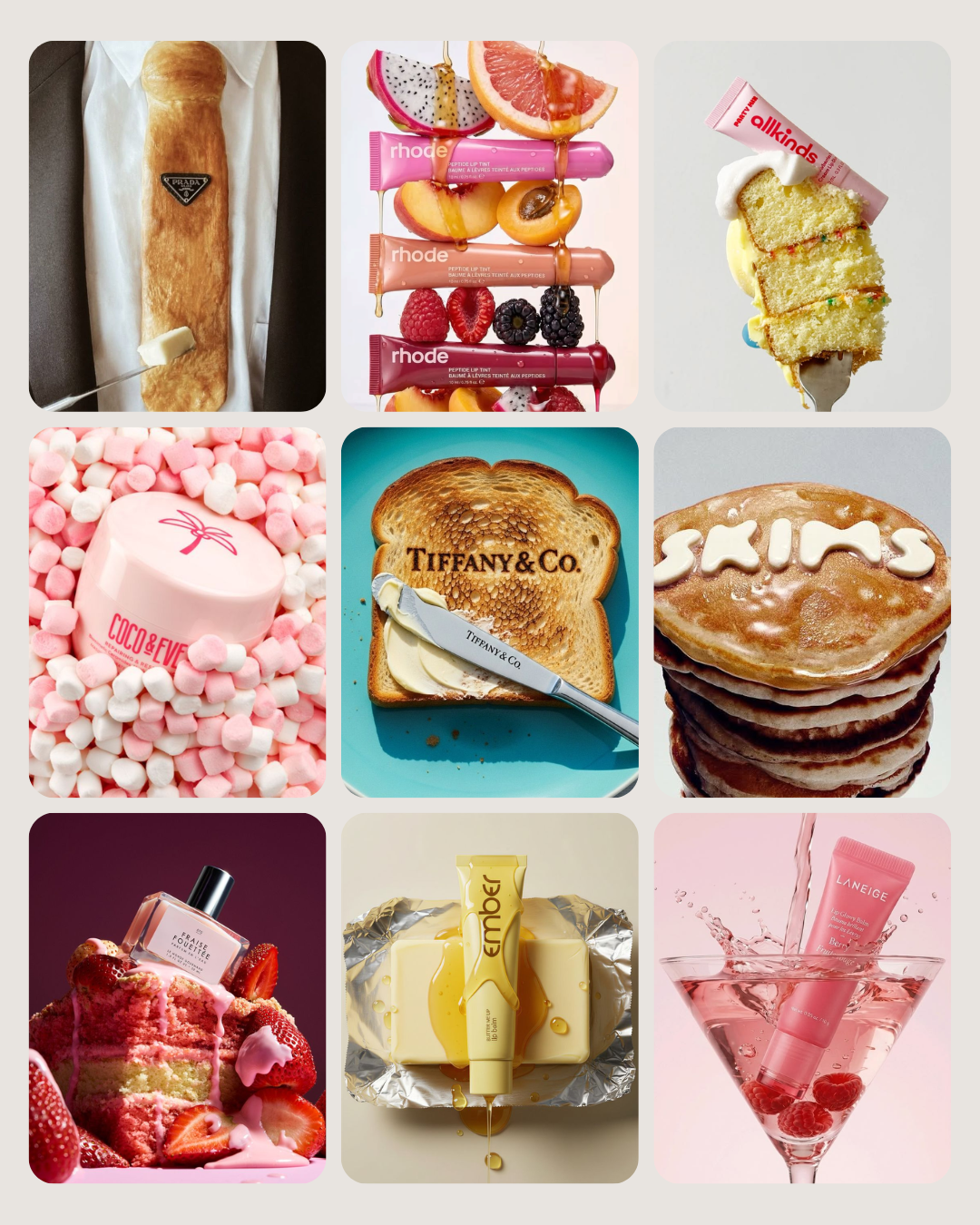
Okay, we need to talk about something, because once you notice it you genuinely cannot stop noticing it.
Every beauty and fashion brand right now is making their products look like food.
Not "food adjacent." Not "inspired by." Literally food. There's a Prada tie that's actually a baguette with a little pat of butter on it. Tiffany & Co. branded onto a slice of toast. SKIMS spelled out in pancake batter and stacked like a Sunday morning. Lip tints sitting in pools of honey next to peaches and dragonfruit. A lip gloss floating in a raspberry martini like it's garnish.
None of these brands sell food. So… what is going on?
Turns out, a lot. Let's get into it.
First, this has a name
The industry calls it gastro-marketing (some people say "foodification," which is also fun to say). It's the deliberate styling of non-food products — makeup, skincare, fashion, fragrance — as if they were something edible, craveable, drizzle-able.
And it's not random. It's one of the smartest sensory plays happening in branding right now, because it hacks something we're all pretty defenseless against: hunger.
Why it actually works
Your brain reacts to food faster than it reacts to a product
This is the whole foundation. We are biologically wired to respond to food — fast, before we even think about it. It's survival stuff.
So when a lip gloss is photographed like a ribbon of caramel, your brain registers crave before it registers that's makeup. You've already had the emotional reaction before your rational brain shows up to the conversation. That half-second head start is everything.
It turns "I'd like that" into "I need that"
Here's the sneaky part. Hunger is basically the most primal want there is. It's not optional — it's a need with a deadline.
When brands borrow that energy, they shift how the product feels. A balm stops being a nice-to-have and starts feeling like a craving. Like the way a slice of cake calls your name at 11pm. Same brain wiring, completely different product.
Texture, texture, texture
Beauty is a tactile category. It's all about how things feel — buttery, glossy, whipped, melty, juicy. And food happens to be the richest texture language we have.
You can't actually touch a product through your phone screen. But you can absolutely feel a drizzle of honey or a fork sinking into cake. So brands borrow food's texture vocabulary to make you feel the product before you ever hold it.
It makes you feel something (and that feeling sticks to the product)
Food isn't just food. Food is comfort. Reward. A treat. A little moment that's just for you. There's a whole warm cloud of emotion around it.
When a brand wraps their product in that imagery, all of those feelings quietly transfer over. The product gets to borrow the coziness, the indulgence, the "you deserve this" of it all — without saying a single word.
It stops the scroll
We can't ignore the obvious one. A lip gloss in a martini glass is confusing in the best possible way. Confusing makes you pause. Pausing is the entire game on social media.
In a feed designed for you to keep flicking past everything, a baguette wearing a Prada tie earns a double-take — and a double-take is a win.
But why NOW?
Trends don't just appear, so let's talk timing.
We're deep in the era of sensory, scroll-native marketing. Platforms reward content that makes you feel something instantly, and nothing does that faster than food. At the same time, "little treat culture" is everywhere — the idea that small indulgences are a form of self-care. Beauty products and a fancy iced coffee live in the exact same part of our brains now: small, affordable, joy-on-demand.
So food styling isn't just a cute visual gimmick. It's perfectly tuned to how we shop, scroll, and treat ourselves in this exact cultural moment.
How brands pull it off well (without being gimmicky)
If you're a brand thinking about this, the trick is restraint. The best examples work because:
The food matches the product's actual vibe. Honey and peaches for a glossy, dewy tint. Pancakes for something warm and comforting. The pairing means something.
The branding still reads instantly. Tiffany on toast still looks unmistakably like Tiffany. The food never swallows the identity.
It's a little bit witty. The best ones make you smile. That tiny moment of delight is what gets the save and the share.
When it's forced, it just looks like a brand chasing a trend. When it's clever, it feels like an inside joke you're in on.
The real takeaway
Here's the thing that makes all of this click: it was never actually about the food.
It's about everything food makes you feel — the craving, the comfort, the reward, the want — and quietly handing that feeling to a little tube of tint instead.
Beauty has always sold a feeling, not a formula. Gastro-marketing is just the most delicious way anyone's found to plate it.
So next time a baguette in a blazer stops your scroll, you'll know exactly what happened. They got you hungry first. 🍓
Let’s talk about yours.
I offer 1:1 brand strategy sessions for founders and businesses ready to build with intention.
Book a session